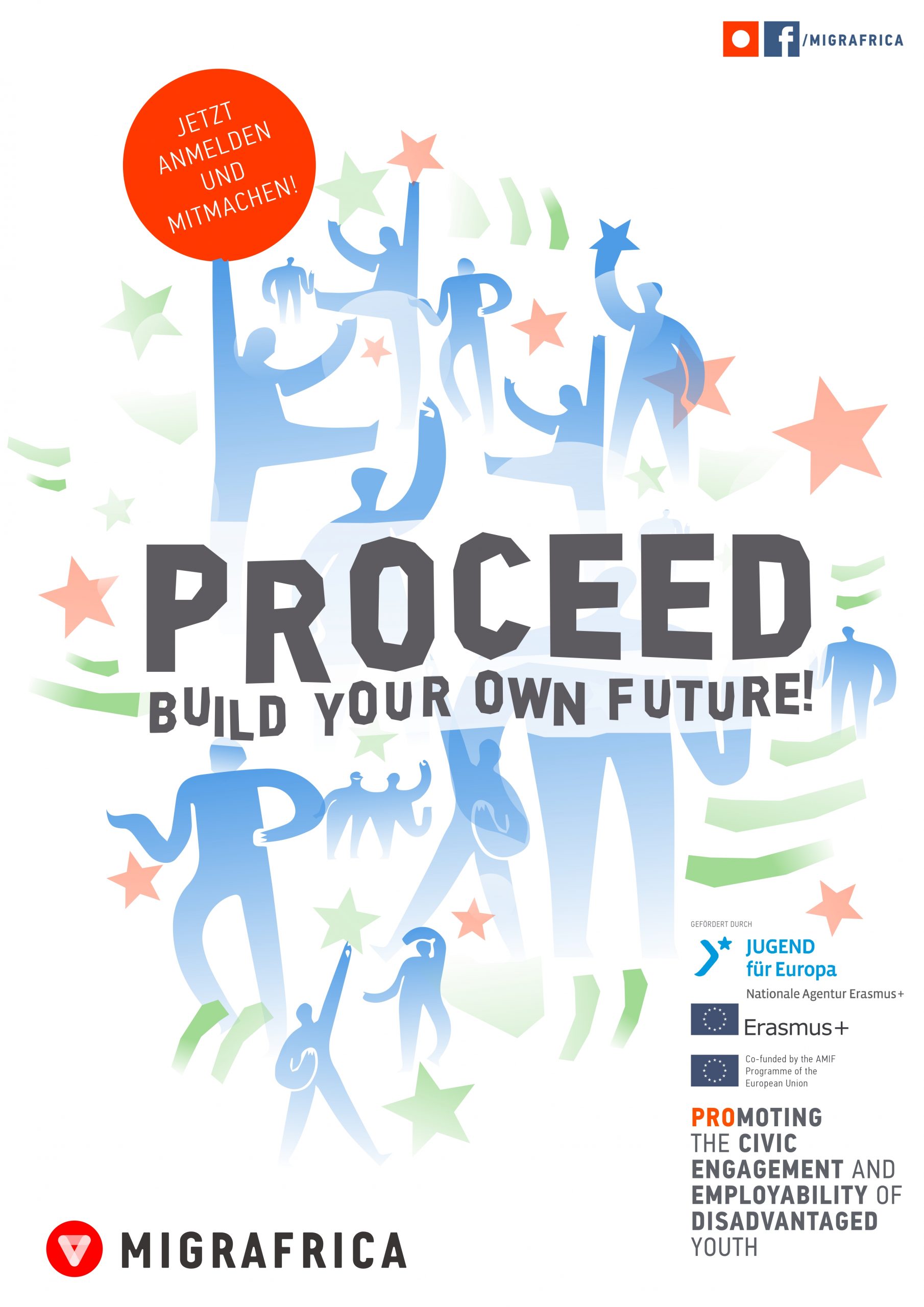
The PROCEED project is dedicated to fostering social and economic inclusion for marginalized NEETs (Not in Education, Employment, or Training) aged 17 to 26. Focused on civic engagement and job training, PROCEED aims to enhance the employability of disadvantaged youth in Greece, Italy, Germany, and Cyprus.
Activities:
- The PROCEED partners will create an open toolkit for youth workers, offering guidance and tools for their daily work.
- Target beneficiaries will undergo pilot model training.
- Additional activities include transnational meetings, multiplier events in all countries, and the establishment of a Community of Practice.
Partnerships:
- Migrafrica (Germany)
With experience in integration, resource mobilization, capacity building, and youth-led initiatives in Germany and Europe, Migrafrica contributes PROCEED project with grassroots insights and coordination expertise.
- International Rescue Committee Hellas (Greece) www.rescue.org/Hellas
IRC Hellas, is part of the IRC global network of offices, whose mission is to help people whose lives and livelihoods have been shattered by conflict and disaster. In PROCEED IRC Hellas ensures smooth collaboration and brings expertise in supporting labour market integration for disadvantaged families and youth.
- CESIE (Italy) www.cesie.org
CESIE is a non-profit and non-governmental organisation that is committed to promote the cultural, social, educational and economic development at local, national, European and
international levels. CESIE supports PROCEED project with expertise in promoting youth entrepreneurship and employability.
- RESET (Cyprus) https://resetcy.com/
The purpose of RESET is to promote a fair and nonviolent world through education, restorative dialogue, skill development among professionals and vulnerable groups, and constructive action. RESET enriches the partnership with its extensive network.
Results:
The project aims to improve the knowledge and capacity of 80 youth workers and practitioners through training, provide exchange study visits for 12 youth workers, support 80 marginalized youth through the PROCEED model, involve 175 participants in multiplier events, and hold 3 meetings for the Community of Practice.
To get the detailed results of the project please visit the website of the project: https://proceedeu.com/
Athens hosts a powerful closing event as the PROCEED project charts a new path for youth inclusion across Europe Athens. (13.11.2025)
In a moment when social exclusion and fragmented systems continue to sideline young people across Europe, the closing event ( at Impact Hub Athens – Coworking & Events space) of the PROCEED project delivered an unmistakable message. With more than one hundred participants joining on site in Athens and many more connecting online from Germany, Italy, Greece and Cyprus, the gathering became a vibrant arena of dialogue, reflection and forward-looking collaboration. The atmosphere in the room was striking: a rare blend of inspiration, professional focus and a sense of working together on the next level of social innovation.

The event opened with a compelling address by Dr. Gelly Aroni, Head of the Unit for Integration and Support of Unaccompanied Minors at the Greek Ministry of Migration and Asylum. She shared the story of Bahar, a young refugee whose journey through five countries before the age of sixteen illustrated the resilience and quiet determination that many young migrants bring with them. Her words underscored a central truth of the day. Integration begins when people are seen, respected and given the space to rebuild their lives. Her keynote set an emotional yet purposeful tone that resonated throughout the conference.
Dr. Abraham Nida from Migrafrica in Germany followed with a reminder that integration cannot be approached through fragmented solutions or quick fixes. Real inclusion requires a holistic frame that takes housing, mental well-being, social networks, skills development and mentorship into account.
Nida emphasised that young people do not thrive through one-off interventions. They grow through trust, long-term relationships and individualised support that recognises their unique trajectories. The contributions from Italy, Greece and Cyprus enriched this picture with diverse local insights. The Italian organisation CESIE highlighted how participatory learning, gamified methods and non-formal education can unlock hidden competencies among NEET youth and newly arrived migrants. Their trainers described how identifying personal skills often becomes the first step toward rebuilding confidence and purpose.

The Greek partner, the International Rescue Committee, presented their findings from extensive focus group work with young people and youth workers. They described a landscape shaped by bureaucratic hurdles, discrimination, homelessness and the daily struggle to access information. Yet they also showed how young people’s resilience, multilingual abilities and soft skills can become a foundation for inclusion when properly nurtured. From Cyprus, RESET illustrated the complexity of NEET situations, showing how migrant status, disability, gender roles and care responsibilities interact. Their work with the Nepalese domestic workers’ community revealed that empowerment is not only about accessing jobs, but also about understanding one’s rights and developing the ability to advocate for them. A significant portion of the event focused on self-advocacy.
Martha Roussou, Senior Regional Advocacy Advisor at RAI Greece, argued that self-advocacy is not an academic concept nor a technical employability skill. It is a life skill that enables young people to take ownership of their voice and their future. She described the subtle but transformative shift that happens when young people no longer view themselves as passive recipients of help, but as active contributors with agency, rights and value.

Her message was echoed by legal expert Eleni Gravani, who explained the urgent need for accessible legal information in a rapidly changing labour market. With new fast-track digital contracts introduced in Greece, many young migrants risk entering employment without understanding their obligations or protections. Her intervention made clear that rights awareness is essential for genuine inclusion.
Throughout the day, the PROCEED consortium presented the toolkits and methodologies developed over two years. These include practical materials for youth workers, competence identification tools, peer learning models and innovative gamification practices tested across four countries.
The presentation made it evident that PROCEED has not only analysed challenges but has built tangible, scalable resources that will continue to serve organisations long after the project’s formal end. As the programme transitioned into an open networking session and a shared lunch, the atmosphere remained energetic and forward-driven. On-site and online participants exchanged contacts, developed ideas for future collaborations and reflected on how the project had expanded their understanding of holistic inclusion. Many described the event as both inspiring and pragmatic, combining heartfelt stories with actionable strategies. The PROCEED closing event in Athens demonstrated that inclusion is not a symbolic gesture. It is a commitment to structure, dignity and opportunity. And as the conversations in the hall made clear, the project may be ending, but the momentum it generated is only beginning to unfold .
Before closing, it is important to honour the people whose dedication, composure and human warmth shaped this remarkable day. As someone who has spent more than three decades working with people, observing how environments influence our sense of belonging and agency, I can say with confidence that events like this do not happen by chance. They happen because individuals care deeply, listen attentively and hold the threads together with both competence and heart.

A sincere thank you goes to everyone who organised, moderated and supported this gathering, both behind the scenes and on stage. My gratitude extends to Roberta Copelli, whose presentation of the Italian chapter of the project brought clarity, authenticity and a much-needed sense of hope. Equally, my warm thanks to Elia Psara, whose presentation and subsequent moderation of the panel discussion demonstrated an exceptional capacity to guide complex conversations with empathy and structure. Her ability to create a space where every voice felt relevant speaks to a rare and invaluable skill.
And finally, a heartfelt and profound thank you to our host, Sissy Karavia. From the first moment to the last, her organisational mastery, calm presence and ability to weave every detail seamlessly together created an environment in which people felt safe, seen and able to contribute. In psychological terms, she provided what we often describe as a “holding space”, a place where others can stand taller because someone else carries the invisible weight of coordination. Today, that was Sissy.

To all of you: your work did more than shape an event. It shaped an experience of connection, trust and collective purpose. For that, we owe you our deepest gratitude.
We would like to express our gratitude for the excellent cooperation and also for the friendly support from the European Union.

PROCEED Final Preparatory Meeting in Athens – Strengthening Cooperation and Setting the Stage for the Final Conference (12.11.2025)
On 12 November 2025, partners from Migrafrica in Germany, IRC Hellas in Greece, CESIE in Italy and RESET in Cyprus met in Athens to complete the final preparatory phase of the PROCEED project. Supported by the Erasmus+ Programme of the European Union, PROCEED has spent two years working to enhance the civic engagement and employability of young people with migrant backgrounds across Europe. The meeting in Athens served as an essential step toward the project’s closing phase and offered a rare moment for partners to align their work in person, reflect on progress and refine all remaining deliverables.
Hosted by IRC Hellas, the gathering brought together professionals who have worked closely with vulnerable youth in some of the most challenging social environments in Europe. The partners reviewed the results achieved so far, confirmed the final structure of the Capacity Building Toolkit and the Best Practices Report and ensured that all materials reflect the practical needs of youth workers. The value of study visits, cross-border exchanges and hands-on collaboration was repeatedly highlighted. These activities helped the consortium understand how similar needs manifest differently in Palermo, Athens, Cologne or Nicosia and how local solutions can inspire European responses.
The discussions moved far beyond organisational checklists. Participants shared insights from their daily work with young people and acknowledged the importance of addressing diverse needs without segmenting migrant communities. Several partners expressed that the project had strengthened not only their organisations but also their understanding of how inclusion evolves in dynamic, multicultural contexts. They emphasised the need for ongoing investment in outreach, particularly for youth living in remote areas who often remain invisible in European programmes.
In a moment of reflection, Abraham Nida, International Project Lead at Migrafrica, noted that PROCEED has demonstrated the transformative power of collaboration, trust and empathy. The meeting closed with a shared sense of purpose as the partners now turn their attention to the Final Conference in Cologne on 29 November 2025. There, the consortium will present its collective achievements and explore new pathways for inclusive youth work in Europe.
We would like to express our sincere gratitude to all partners and participants for joining us in Athens and for sharing your valuable experiences, insights and expertise. Your commitment, dedication and openness have enriched the PROCEED project far beyond the formal requirements and have shown what true European cooperation can achieve.
Thank you for your ongoing engagement, your professionalism and your belief in the importance of empowering young people across our communities. Your contributions have shaped this project, strengthened our partnership and created impact that will continue long after the project ends.
We deeply appreciate your presence, your energy and the spirit of collaboration you brought to these days. It has been a privilege to work with you.
Migrafrica Visit to Athens: Strengthening International Cooperation and Exchange (16-19.07.2025)
On July 18–19, 2025, a delegation from Migrafrica visited key organizations in Athens as part of our commitment to international cooperation within the PROCEED project, promoting civic engagement and employability among disadvantaged youth. Our goal was to exchange insights, strengthen networks, and explore future collaborations for legal migration and employment opportunities.

Our first visit was to the International Rescue Committee (IRC Hellas), where we gained insights into the “Helios Plus” project. Funded by the EU and Greek government, Helios Plus supports recognized refugees through integration into the labor market and Greek society. Services include vocational training, Greek language courses, housing assistance, and community-building activities. IRC Hellas showcased innovative methods like narrative counseling to empower refugees by reshaping personal stories and externalizing challenges, promoting emotional resilience, and integration.

We then visited the Solidarity Center, a longstanding NGO-led hub funded by the EU, UNHCR, and Swiss–Greek Cooperation, dedicated to holistic support for refugees and vulnerable populations. Services include legal aid, psychological counseling, employment support (including AI & digital skills training), language education, and outreach initiatives. Their efforts in providing tailored programs, especially for women and refugees with disabilities, demonstrated exceptional commitment and innovation.
Our third stop was the Migrant Integration Center (MIC), operated by the Municipality of Athens, serving as the largest municipal integration hub. MIC offers comprehensive social services, including psychosocial support, legal counseling, housing assistance, language and digital literacy courses, and employment counseling. The center’s approach integrates migrants into local cultural life through intercultural arts and sports, fostering meaningful community connections.
Throughout our visits, common themes emerged: empowerment, inclusivity, anti-discrimination, and proactive community engagement. The organizations shared our vision for creating sustainable integration pathways, highlighting the importance of tailored support, cultural sensitivity, and robust collaboration between civil society, municipalities, and governmental institutions.

Migrafrica’s delegation was particularly inspired by the effective synergy of psychological and social services, vocational training, and employment support across the three organizations. The visit opened numerous avenues for future cooperation, particularly regarding structured pathways for legal migration to Germany, joint training initiatives, and knowledge exchanges on effective integration practices.
We express our deep appreciation to IRC Hellas, the Solidarity Center, and MIC Athens for their impressive dedication, innovative methods, and openness to collaboration. These partnerships will undoubtedly enrich our efforts to enhance civic engagement and employability opportunities for disadvantaged youth within the PROCEED project framework.
Migrafrica is committed to leveraging these international experiences to foster a more inclusive and supportive environment for refugees and migrants, both locally and globally.
We would like to express our gratitude for the excellent cooperation and also for the friendly support from the European Union.